Krishaka
Krishaka builds autonomous, sensor-driven farm vehicles, and needed a site that could make an unfamiliar piece of machinery make sense at a glance. I designed and built it solo as a freelance engagement, centered on a hand-built scroll-driven Three.js viewer that lets a visitor rotate each vehicle into view simply by scrolling.
Visit site →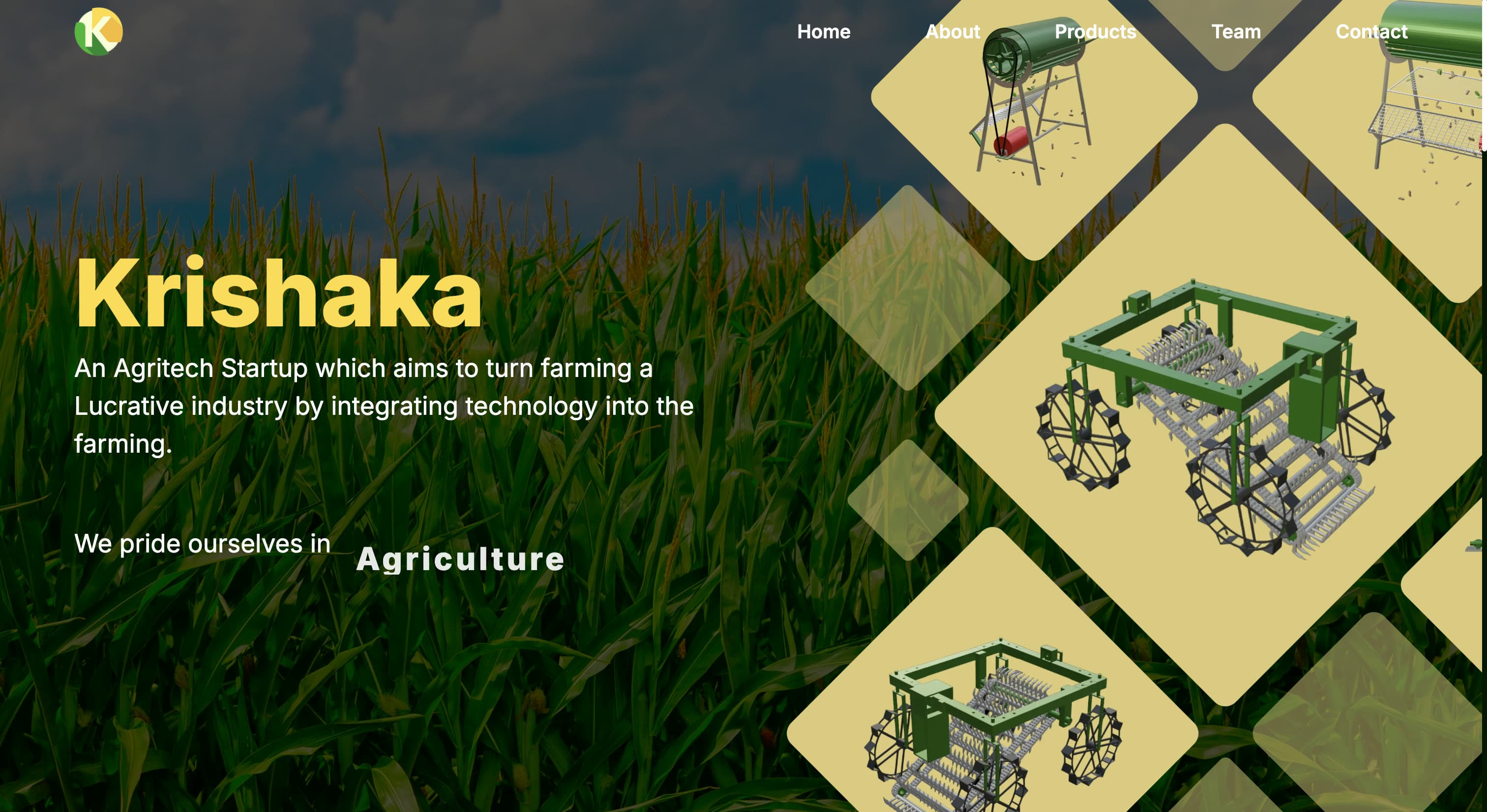
Krishaka's vehicles, autonomous machines for tasks like groundnut harvesting and filtering, worked well, but the company had no real way to show that. Farm machinery is visually unfamiliar to most site visitors, and a page of bullet points about sensors and filtration mechanisms doesn't build understanding, it builds skepticism. The company needed a site that let a stranger grasp what each vehicle does and why it matters, at a glance, without reading a spec sheet.
- Built a scroll-driven 3D viewer from scratch for each product page with Three.js: each vehicle is a rendered 3D model, and the page's scroll position is mapped directly to its rotation, so scrolling down turns the machine to show it from every angle and scrolling back up reverses it.
- Structured the three product pages as thin wrappers around one shared template instead of three near-duplicate pages, so all three vehicles got the same polished, scroll-driven explainer and any improvement to the template benefited all three at once.
- Centralized all copy, team bios, and contact details in a single typed data file, giving the client one obvious place to update content later without touching component code or paying for a full headless CMS.
- Kept the stack entirely static: the contact form posts straight to a Google Form, so the whole site is host-anywhere with no backend, no database, and nothing for a small team to maintain after handoff.
- Owned the full loop alone: translating the brief into an information architecture, designing the visual language, and building the frontend.
The result is a site where a visitor can understand what each vehicle does simply by scrolling, without reading a spec sheet or waiting on a hosted video. Krishaka got a fully static, host-anywhere marketing site with zero backend to maintain, and a single content file they can update themselves as the product line grows.
- A scroll-linked animation can build trust in an unfamiliar product faster than paragraphs of spec detail, since it lets the visitor set their own pace instead of committing to watching a video.
- Designing for a client who will maintain their own content long after the engagement ends changes what "done" means: a single typed data file mattered more here than any clever component abstraction.
- Working solo end to end sharpened my sense of when to hand-build a piece (the Three.js viewer, tuned exactly to this use case) versus reach for a library (Swiper for the carousel), instead of defaulting to either out of habit.